
If an employer violates OSHA regulations and a worker is injured or killed as a result, our attorneys may be able to help.

Occupational Safety & Health Administration
OSHA has a slew of regulations that employers are supposed to follow and enforce to keep the workplace safe. When an employer fails in their responsibility to uphold OHSA standards, they open themselves up to fines and potential personal injury lawsuits.
OSHA violations range in severity, and are outlined by the law. Here’s a short overview the top 10 most-violated regulations of 2016:
1) Fall Protection
Workers who have to carry out their daily duties on ladders or above ground are exposed to the danger of falling and injuring themselves. This is especially true for those that work in the construction and cleaning businesses. According to OSHA, employers are supposed to determine if the surfaces that employees work on have an adequate amount of structural integrity to safely support workers. Fall protection goes on to cover things like harnesses, protection from falling objects, installation of guardrail systems, covers around holes and more.
2. Hazard Communication
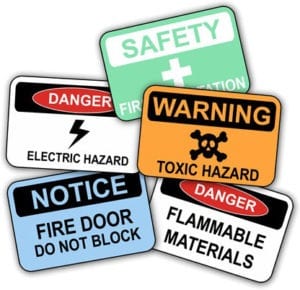
Workers who have to carry out their daily duties around toxic substances should be provided with adequate protection by means of classifying all hazardous chemicals. In addition, employers are required to ensure that all safety data sheets of chemicals that employees come into contact with are easily available to them during work.
3. Scaffolding
Scaffolding is often used in construction sites. These contraptions are useful when an employee wants to move from one point to the other on the outside perimeter of a structure. According to OSHA regulations, scaffolding should be able to sustain and support at least 6 times its intended load. In addition, scaffolding is supposed to be designed and constructed by a qualified person and according to OSHA guidelines.
4. Respiratory Protection
Workers who carry out their duties in environments that expose them to respiratory contaminants such as smoke, vapors, gasses, fogs, dust and mists should be provided with respirators that are approved by OSHA standards. In addition, employers are required to develop and implement a written program outlining respiratory protection protocols in this kind of environment.
5. Lockout/Tagout
Those that work in environments that may expose them to sudden energy bursts (such as electrical circuits, conveyor belts, hydraulic presses, etc) are protected by regulation which requires employers to come up with energy control procedures as well as training meant to equip workers with knowledge that will keep them safe at all times. When used correctly, the lockout-tagout system is effective in securing equipment against accidental energization during maintenance or repair.
6. Powered Industrial Trucks
This has to do with employees who have to work with machinery such as forklifts, tractors, lift trucks and others. An employer is required to purchase machinery that has been approved by the American National Standard for Powered Industrial Trucks, Part II, ANSI B56.1-1969. According to OSHA rules, these types of machinery should also not be used in environments containing hazardous levels of metal dust such as magnesium and aluminum.
7. Ladders
OSHA requires that all ladders be able to hold at least 4 times its maximum intended load. In addition, ladders are supposed to have parallel and uniformly-spaced rungs, cleats, and steps at all times. Lastly, this equipment should be coated with slip-resistant material and be corrugated to minimize the chances of a worker slipping and falling off it.
8. Machine Guarding
According to OSHA regulations, machines that may potentially expose a worker to injuries should be guarded at all times. In addition, employees should be provided with special hand tools to help them operate certain types of machinery that may pose a hazard to their hands. Machines covered under this sub-regulation include guillotine cutters, shears, power presses, power saws and more.
9. Electrical Wiring
This OSHA sub-regulation covers wiring, cable sheaths, fittings and conductors. As a rule of thumb, employers are required to ensure that installation and maintenance of electrical and wiring systems is done by qualified personnel and maintained on a regular basis. OSHA also requires that employers only install certain types of cabling to ensure maximum safety at all times.
10. Electrical, General Requirements
This covers any electrical equipment. OSHA requires that employers ensure that all equipment be free from hazards that may cause serious harm or death on the part of employees. Additionally, things like wiring installations should be free from short circuits which could cause electrocution.
For an in-depth look into these guidelines, please click here.

Hurt on the job? Speak to a lawyer for free.
When these standards and guidelines are not followed and someone is injured on the work site as a result, OSHA may investigate and levy fines against the employer. Unfortunately, the fines OSHA is allowed to levy are often low and ineffective as a deterrent.
Even if no one has been injured as a result of a violation, you are still encouraged to report such violations to OSHA. Our law firm may be able to help facilitate this process while shielding you from retaliation (see: OSHA whistleblower protection).
If a worker is injured or killed on a construction site (or any other work site) the victim or their family needs to contact a personal injury lawyer as soon as possible. Do NOT make the mistake of waiting for OSHA to complete their investigation, as this can take up to six months. An attorney will go over the facts of your case and determine the legal options available to you and your family for no charge. If you decide to hire our law firm, we never charge you a single cent unless we’re able to successfully recover money on your behalf.
Rasansky | McKenzie Law has over two decades of experience with these kinds of workplace accidents and OSHA violations. Please call us today at 1-800-ATTORNEY (1-800-288-6763) or email us via the form on this page for your free consultation. We look forward to helping you get the justice and compensation you need and deserve.
Speak With a Dallas Personal Injury Attorney For Free
The attorneys at Rasansky | McKenzie Law are happy to speak to you about your potential case free of charge. If we can help with your claim, we’ll do so for no out-of-pocket cost to you. Call us 24/7 at (214) 651-6100.