


Product liability lawsuits commonly involve products such as vehicles, cribs and other baby products, over-the-counter and prescription drugs, medical devices, medical equipment, tainted foods, household products, toys, appliances, and even fireworks.
How do products become dangerous? Some defective products are produced due to a manufacturing mistake, while others have design flaws that make them inherently prone to causing injury. In other cases, products may not have been advertised correctly or the company that made or sold the product did not properly warn users of foreseeable dangers or how to safely use their product.
If you or a loved one has been injured due to a defective or otherwise unsafe product, we urge you to call Rasansky | McKenzie Law and discuss the facts of your case with our attorneys (for free) at (214) 651-6100.
Read more on product liability.
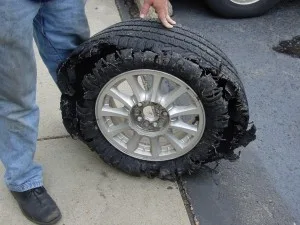
Was your car accident caused by a tire blowout, tread separation, or otherwise defective tire?
Call the Dallas accident attorneys at Rasansky | McKenzie Law today at (214) 651-6100 to discuss the facts of your case, and let us explain the options available to you moving forward for no cost.
Tires are a vehicle’s only points of contact with the road. There’s a lot of engineering that goes into the design of a tire, and it’s extremely important that you make sure that your vehicle is fitted with the correct tires, that they are properly inflated, and have plenty of tread left.
When a tire fails and causes a car accident, you may be left wondering if the manufacturer (e.g. Goodyear, BFGoodrich, Firestone, Michelin, Toyo, etc) produced a defective product. You might have concerns that the tire shop (Discount Tire, Walmart, NTB, Pep Boys, etc) negligently installed old tires or the wrong size tires altogether. Both of these scenarios are possible, and the best way to determine this is to have an attorney perform a free initial investigation into the matter.
These types of claims can be quite complex, which is why we strongly recommend discussing your potential case with an experienced attorney. Luckily, the lawyers at Rasansky | McKenzie Law take these cases on contingency, meaning you never have to risk a penny of your own money to pursue your claim.
Even if you’re unsure whether or not your accident was caused by a defective tire, a nail in the road or something else, our law firm can investigate the facts of your case for no charge.
It’s not uncommon for tire shops to store tires for long periods of time, leading to their deterioration before installing them onto a vehicle. It’s also very likely that a tire has been recalled, but no recall notice was ever sent out to you. Owners are only contacted about recalls if they have registered their tires, but it’s estimated that only about 10% of tires sold by independent tire dealers are ever registered.

What causes tire blowouts?
When a vehicle suffers a catastrophic tire blowout, it’s often a result of tread separation (AKA detreading or delamination) at high speed. What this means is that the rubber tread layer detaches from the rest of the tire, often leading to total failure of the tire.
When a vehicle starts to wobble or vibrate while moving at speed, it’s best to take your foot off the gas, pull over to the side of the road, and coast to a complete stop. Unfortunately for many drivers who’ve found themselves in this situation, tread separation often leads to total tire failure in the matter of a split-second. A high-speed tire failure often results in total loss of control, and can lead to a rollover accident.
If your tires were in good condition prior to the crash, it’s vital that you have an attorney look into the root cause of the blowout. The police are not going to investigate the cause of your flat tire or blowout, but an attorney will (and for no charge to you). Additionally, If your car, truck or SUV suffered a blowout accident due to being fitted with the wrong kind of tires, you may even have a valid claim against the negligent body shop or tire shop.
Defective tire accidents range in severity. Let’s take a look at some of the most common scenarios:
- Vehicles with high centers of gravity, such as SUVs, may have their tires suffer from tread separation (or delamination), leading to a blowout. Once this happens, the vehicles becomes destabilized, making it prone to roll over. Rollover accidents are terrifying, and can result in catastrophic injuries for everyone concerned.
- Tire beads are responsible for helping keep a tire in place while on the road. Should these come off on account of them not being properly reinforced, a tire may lose pressure leading to a blowout, and consequently, an accident.
- Tire sidewalls are responsible for stopping air from escaping from a tire. On top of that, they help protect parts of the tire, strengthening it from outside forces. Poor manufacturing or lack of proper testing may result in the formation of bubbles or sidewall separation, unbeknownst to the car owner. Before long, strange noises, vibrations signaling tire sidewall breakdown may go unnoticed, resulting in a blowout and an accident.
- During routine service at a tire center, your tires could be incorrectly installed by personnel, jeopardizing your safety. In such cases, you can file a negligence lawsuit against the service center citing that the owners breached their duty of care when servicing your vehicle.
- Ozone cracking due to the exposure of tires to improper manufacturing standards leads to the formation of cracks on the surface of a tire which compromise its integrity. This can be due to improper storage by the tire maker, design or manufacturing defects, or the use of inferior materials during the making of the tire.
How to avoid a tire failure.
As a conscientious driver, it’s important to do your part to prevent potential accidents caused by tire blowouts. This can be done via regular tire inspections, opting to change your tires more often than is recommended, keeping abreast of recall news in order to know if there’s a tire recall affecting your vehicle, and watching out for certain signs which might signal a tire blowout is on its way.
We recommend inspecting your tires at least once a month. Check the tire pressure (which changes depending on temperature) and ensure your tires are inflated to the recommended PSI, watch out for things like cracks/blisters/bulges on the surface of your tires, as well as tread wear which looks uneven. If you experience any unexplained vibrations when driving, have your car checked by a mechanic. Don’t overlook anything nor second-guess yourself. A vigilant outlook may just keep you and your loved ones safe.
Frequently Asked Questions
What is product liability?
When a person is harmed because of an unsafe or defective item, they may suffer serious injuries and other long-term consequences. These types of injury claims are referred to as “product liability” claims. These claims are usually filed against a manufacturer and/or retailer whose negligence contributed to the injury.
What’s the deal with this massive airbag recall? Am I entitled to a free repair?
Takata, the company who produced the defective airbags specified in this massive recall, announced in May of 2015 that they are doubling the number of recalled vehicles in America from 18 million to nearly 34 million. This is by far the largest automobile recall in history, and one of the largest consumer product recalls ever issued.
According to the National Highway Traffic Safety Administration (NHTSA), these defective airbags can explode upon inflation, sending shrapnel into the face and body of the driver and front seat passenger. At least 17 deaths and well over 100 injuries have been tied to these defective airbags so far.
Car companies affected by this recall include, but are not limited to: Acura, BMW, Chrysler, Dodge, Ford, Honda, Infiniti, Lexus, Mazda, Mitsubishi, Nissan, Pontiac, Saab, Subaru, and Toyota.
This recall is so expansive that every car owner is being asked to contact their local dealership in order to determine if their vehicle has been recalled. Alternatively, you could check the NHTSA’s recall website at https://vinrcl.safercar.gov/vin/. Be aware that the most recent additions to this recall may not show up immediately through this web app, and the NHTSA recommends that you check back periodically.
If your vehicle is listed in this recall, you’re asked to contact the manufacturer’s customer service department or your local franchised dealership to inquire about scheduling a no-cost repair. If you’ve already been in an accident and were injured by airbag shrapnel, you may very well have a valid product liability claim with which our attorneys may be able to help. Call us for a free consultation at (214) 651-6100 for more information.
Could defective tires be to blame for my car accident?
All of the major tire companies, including Goodyear, Bridgestone, Michelin, and Cooper, have all announced defective tire recalls in recent years. And each year in Texas, hundreds of car accidents are caused by tire blowouts, separated treads, belt separations, sidewall defects, and split rims. While some of these accidents may be cause simply by the age of the tire or other considerations, other car accidents are caused by tire defects that should have been prevented by the manufacturer. If your Dallas car accident was caused by a defective tire, speak to our Dallas product liability attorneys today.
Could my car fire have been started because of a product defect?
Did you know that 20 percent of all reported fires are car fires? While there are many causes of car fires (such as poor maintenance or an intentional act) many car fires are caused by a manufacturer defect or a defective auto part.
Defective fuel systems and faulty wiring are two common auto manufacturer mistakes that can lead to serious car fires, car explosions, burn injuries, and even wrongful deaths.
If you were injured in a car fire that was caused by a defect in your vehicle, you may have a valid product liability claim. To talk with a Texas automobile product liability lawyer about your case today, call (214) 651-6100.
Why are drop-side cribs dangerous?
In 2011, the U.S. Consumer Product Safety Commission (CPSC) passed a law prohibiting the sale and manufacture of drop-side cribs.
Drop-side cribs are cribs where one or both sides of the crib can be moved up and down for better accessibility. While many parents found the drop sides convenient, drop-side cribs were responsible for at least 32 infant deaths between 2000 and 2010. According to the CPSC, an additional 3,520 incidents and injuries were reported from November 1, 2007, to April 11, 2010, involving drop-side cribs. Injuries included suffocation, strangulation, entanglement, broken bones, and skull fractures. Most of these injuries and deaths occurred when a drop rail partially detached and a gap formed between the drop rail and the mattress. The child was either fell through the gap or was caught and suffocated or strangled.
Under the new guidelines, crib manufactures are required to use stronger materials and hardware. Crib slats must be well attached and drop sides are banned. While you can still find drop-side cribs at yard sales and on Craigslist.org, our Dallas product liability attorneys suggest that you purchase a crib that meets the current safety guidelines.
The Dallas attorneys at Rasansky | McKenzie Law work to hold crib manufacturers responsible for injuries caused by defective or poorly made cribs. To discuss a crib injury claim, contact Rasansky | McKenzie Law at (214) 651-6100.
How can I be sure that I'm using safe baby gear?
In October 2012, nine out 24 consumer recalls were for children’s products. Every month, at least one highchair, stroller, or baby seat seems to be recalled. You are right to be concerned.
Here are a few tips to help you choose safe gear for your child.
Strollers – Strollers are one of the most frequently recalled children’s products. Many stroller recalls are due to a large gap between the stroller grab bar or tray and the seat bottom. If an infant is not properly harnessed, the child can slip through the gap into a strangulation hazard. Other strollers have been recalled because exposed hinges can amputate small fingers. Most companies offer free repair kits to fix these issues.
Cribs – since 2007, the Consumer Products Safety Commission (CPSC) has recalled 11 million cribs. Last year, the CPSC issued new rules for manufacturers of cribs. Cribs must now be made of sturdier materials and must pass tougher product safety tests before they can be sold. Check your crib to make sure that it is properly assembled and that there are no gaps larger than two fingers between the sides of the crib and the mattress. If your crib has a drop-side, stop using it and see if a retrofitting kid is available from the manufacturer. Never use a crib that is more than ten years old.
Play yards – More than 2,100 accidents involving play yards have been reported to the CPSC. These incidents resulted in 170 injuries and 60 fatalities. In June, the CPSC approved new safety standards for all play yards. These include stricter testing including stability testing, entrapment testing, and floor strength testing as well as minimum side height requirements and latch-and-lock mechanisms. If you use a pack and play, play yard, or play pen, make sure that the mattress pad is well-attached and that you are not using any extra padding. Discontinue use if you notice any problems with the hinges.
Baby seats – Millions of Bumbo seats were recalled after more than 75 babies suffered head fractures when they arched their backs or rocked and tipped the seats over. If you have a Bumbo seat, make sure it includes a restraint belt. Never use it on a raised surface.
Check manufacturer web sites – Manufacturer websites are the best place to find information about recalls and safety alerts. You can also fill out online product registrations to have recall notices mailed or emailed to you.
If your child is injured by a defective children’s product, our Dallas product liability lawyers can help you get accountability and compensation through a Texas defective product lawsuit. To discuss your claim, contact Rasansky | McKenzie Law at (214) 651-6100.
Tire blowouts and product liability law.
More often than not, tire blowout cases fall under the concept of product liability. In such cases, you don’t have to prove negligence, but only have to prove that the tire in your car was defective, and that it is this defect that proximately caused your car to crash, resulting in your injuries. This concept is known as strict liability, and it is different from common injury cases which require you to prove negligence.
Evidence is key in these kinds of cases. This means that you will have to act fast to get a car accident attorney to preserve any evidence which is salvageable (e.g., the tire in question, photos of the accident scene, witness testimony, etc). This evidence will enable your attorney to build a strong case, and could even help you secure an out-of-court settlement early on in the process.
Get legal help today!
If you’ve been in an accident that you suspect was caused by a defective tire, speak to us immediately. We’ll review the facts of your case and explain the legal options available to you for no cost. If we can help with your claim, we’ll carry out a full investigation and collect evidence to help build a strong case to ensure that you get the maximum amount of money damages that you deserve. You’ll never have to risk a dime of your own money, as we work on contingency.
Call us today at (214) 651-6100 for your free, no-commitment consultation. Thanks for choosing us, and we look forward to hearing from you.
By Jeff Rasansky
Speak With a Dallas Auto Accident Attorney For Free
The attorneys at Rasansky | McKenzie Law are happy to speak to you about your potential case free of charge. If we can help with your claim, we’ll do so for no out-of-pocket cost to you. Call us 24/7 at (214) 651-6100.
